A look at the life cycle of an air filter clearly shows: the highest costs do not arise from the initial purchase but during ongoing operation. Using a fine dust filter of filter class ISO ePM₁ as an example, it becomes evident how significant energy consumption is: over the entire service life, typically only 10% of the costs are attributed to procurement, 7% to maintenance, 3% to disposal – but a full 80% to energy consumption.¹
In addition to filter efficiency, which plays a key role in meeting indoor hygiene standards, another factor is gaining importance: the energy consumption of the air filter – and thus its long-term cost-effectiveness.²
¹ See VDMA (2021), p. 2.
² See VDI (2021), p. 5.
In commercial buildings, approximately 50% of the total energy consumption is attributed to the ventilation system (HVAC). About 16% of that energy is used solely for operating the air filters – which corresponds to roughly 8% of the building’s total energy consumption.
Modern ventilation systems regulate airflow according to demand via fan power. As the resistance of an air filter increases due to accumulating dust, the so-called flow resistance – the pressure difference between the supply and exhaust sides of the filter – rises. To maintain the required airflow, the fan must work harder, which in turn increases energy consumption.³
³ See VDI (2021), p. 4.
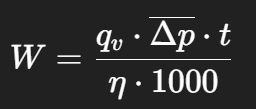
To objectively compare the energy consumption of different air filters, the following standardized calculation method can be used. The focus is on the average pressure drop that occurs over the filter’s operating life. This pressure drop has a decisive impact on the fan’s power demand — and thus on the operating costs.
 |
Explanation | Standardized Calculation Parameters (for Comparability) |
| W | Energy consumption in kWh per year | |
| qv | Volumetric flow rate (m³/s) | 0.944 m³/s (equivalent to 3400 m³/h) |
| medium Δp | Medium Pressure Drop (Pa) | The average pressure difference is determined by a standardized dust loading of the filter over one year |
| t | Operating time per year (hours) | 6000 hours/year |
| η | Fan efficiency | 50 % |
| 1000 | Conversion factor from watts to kilowatts |
The higher the pressure drop over the lifetime of a filter, the more energy a fan must exert—leading to higher electricity costs. An efficient air filter therefore not only helps maintain air cleanliness but also saves energy.
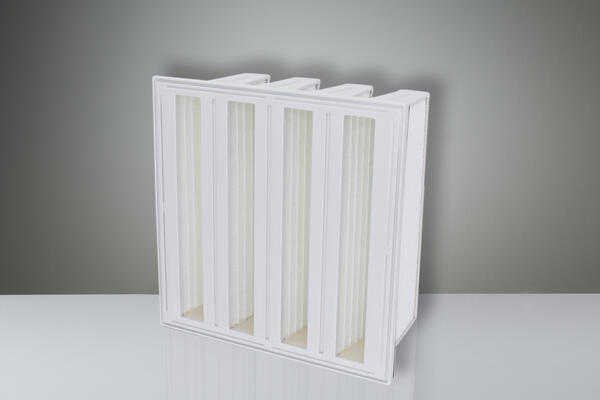
A comparison of different filter types — all with filter class ISO ePM₁ 60% and a nominal airflow of 3400 m³/h — illustrates how much total costs can vary over one year.
Filter 1 (panel filter with cardboard frame) is initially the cheapest option with a purchase price of €31 but incurs operating costs of €781.50 due to an energy consumption of 2,605 kWh/year. This results in total costs of €812.50 per year.
Filter 2 (pocket filter) costs €36 to purchase. However, due to a high energy consumption of 1526 kWh/year, it generates energy costs of €457.80, leading to total costs of €493.80.
Filter 3 (compact filter) has the highest purchase price at €86 but impresses with the lowest energy consumption of only 1084 kWh/year and thus the lowest operating costs (€325.20). This results in the overall lowest total costs of €411.20.
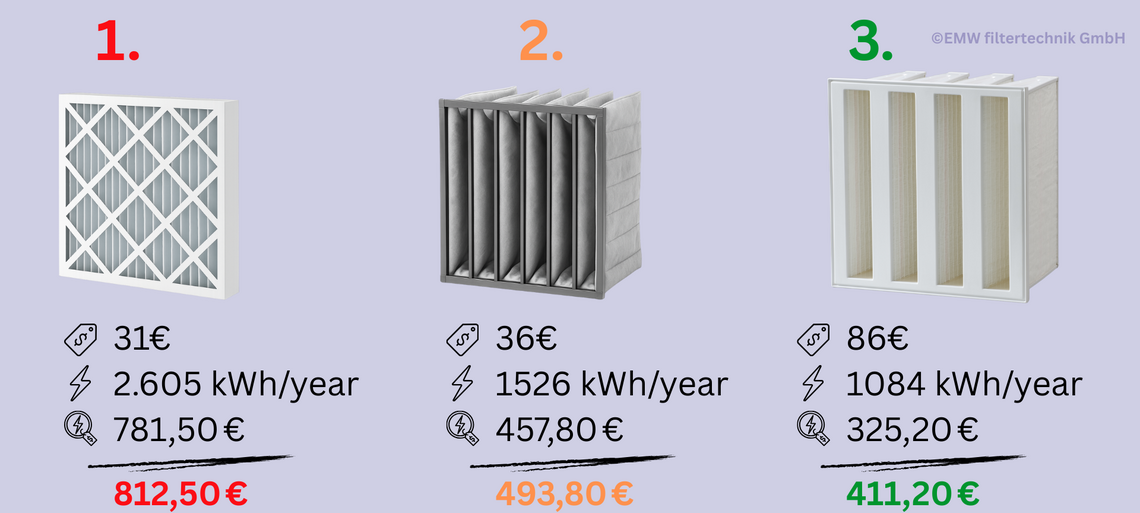
Although the compact filter is more expensive to purchase, it offers the best cost-benefit ratio over its lifecycle due to its low energy consumption.
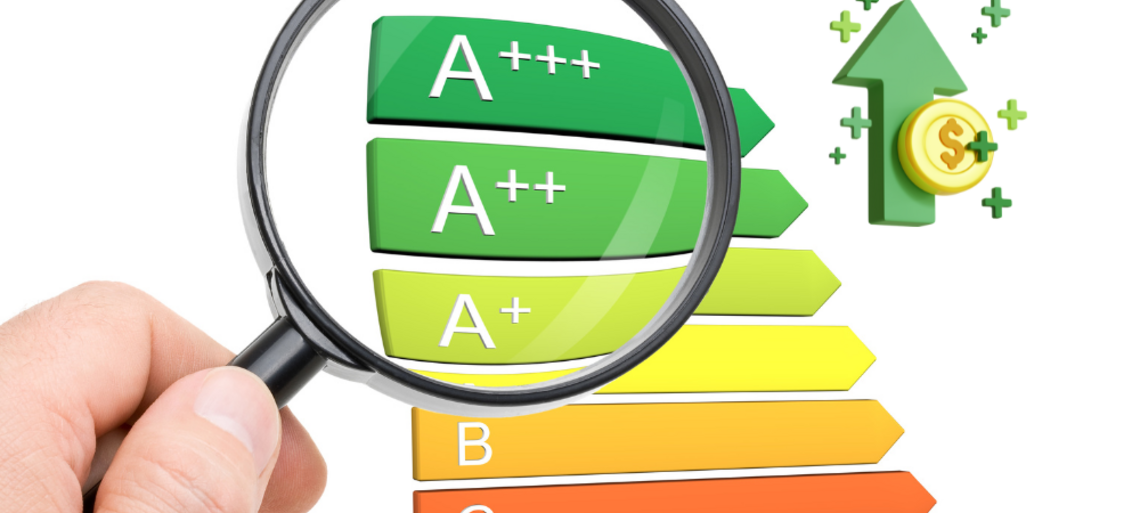
Energy-efficient air filters offer a simple, immediately effective way to significantly reduce the energy demand of these systems—without compromising air quality.
High-quality air filters are designed so that their pressure drop increases more slowly, contributing to noticeably lower energy consumption—without sacrificing filtration performance.
An energy-efficient filter thus not only ensures clean air but also measurably lower operating costs.
The calculation formula presented enables a quick comparison of different filter solutions under standardized conditions. It should be noted, however, that parameters such as volumetric flow, operating time, or fan efficiency can vary significantly in real-world operation—due to partial load operation, intermittent use, or fluctuating air volumes.⁴
Our tip: For a reliable assessment of energy efficiency, an individual analysis of your filter system is worthwhile. Our team is happy to support you—practically and data-driven.
⁴ See Ruben et al. (2024), p. 2.
Ruben, M., Kopic, C., Schumann, L., Kriegel, M. (2024): A Comprehensive Index for Evaluating the Effectiveness of Ventilation-Related Infection Prevention Measures with Energy Considerations: Development and Application Perspectives, Hindawi Indoor Air, Volume 2024, Article ID 9819794, pp. 1–16.
VDI Verein Deutscher Ingenieure e.V. (2021): Informationen zum Einsatz von mobilen Luftreinigern, excerpts from the expert recommendation VDI-EE 4300 Blatt 14, pp. 1–7.
VDMA (2023): Energy-Efficient Air Filtration – Saving Costs Through Efficient Air Filters, Frankfurt, pp. 2–24.