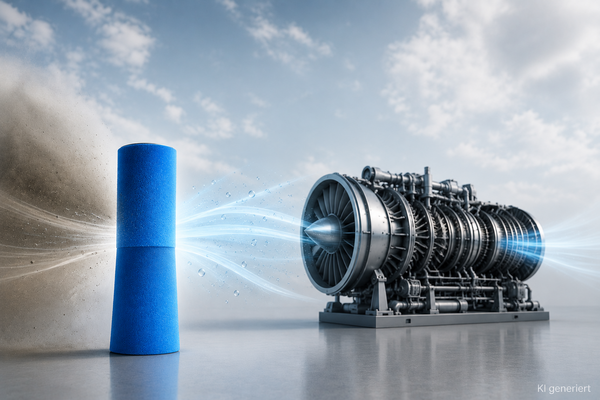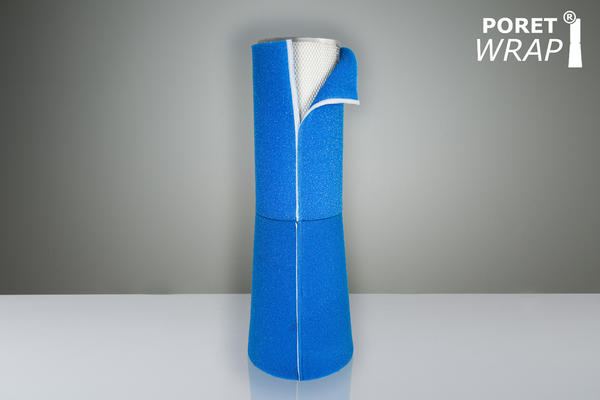
The following comparison according to ISO 29461-2 shows the influence of air humidity on the filter performance of cartridge filters in direct comparison – with and without of Poret®Wrap by EMW®. For resilient results in accordance with standards, the tests were conducted according to ISO 29461-2.
Cartridge filters, commonly used in combined cylindrical and conical designs, reliably protect gas turbines from particles in the intake air and play a key role in ensuring safe plant operation. However, under conditions of high humidity, the pressure drop of conventional filter media often increases significantly, resulting in reduced service life and even unplanned turbine shutdowns. Additional dust loading further intensifies this risk. Poret®Wrap acts as an effective protective shield: As a pre-filter media, it reliably protects cartridge filters against coarse dust and moisture ingress, supporting stable and cost-efficient operation of gas turbine filtration systems. The following comparison demonstrates the direct impact of humidity on filter performance.
For reliable and comparable results, the test was carried out in accordance with ISO 29461-2.
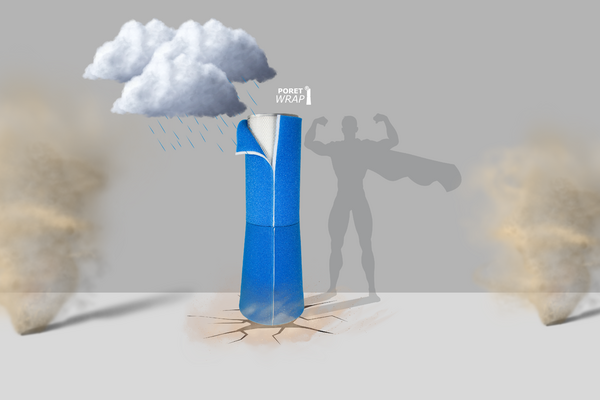
For the comparative study, two identical cylindrical cartridge filters – one equipped with Poret®Wrap and one without pre-filter media – were installed in a test duct and tested under defined humidity conditions in accordance with ISO 29461-2. The evaluation focused on pressure drop development, initial pressure drop, test duration, and the amount of water introduced during the test.
At the very beginning of the test, it became evident that the two filters differed only marginally in terms of their initial pressure drop. The filter equipped with the Poret® wrap exhibited an initial pressure drop only 13 Pa higher than the reference filter—a negligible increase in flow resistance considering the effective protection it provides for the cartridge filter.
| Comparison according to ISO 29461-2 |
Cylinder without Poret®-Wrap | Cylinder with Poret®-Wrap |
|---|---|---|
| Initial pressure drop | 234 Pa | 247 Pa |
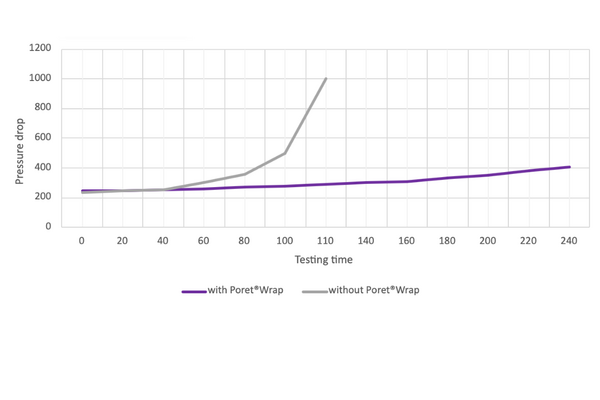
The decisive difference became apparent as the test progressed. While the cartridge filter without the Poret® wrap reached a critical pressure drop increase from approximately 234 Pa to 1,000 Pa after only 105 minutes, the pressure drop of the filter equipped with the Poret® wrap remained nearly constant at just under 300 Pa over the same period.
Even after 240 minutes, the pressure drop of the filter with the Poret® wrap was only about 410 Pa, despite approximately 30.6 kg of water being sprayed during the test (see the chart below). Consequently, the filter equipped with the Poret® wrap was exposed to approximately four times the amount of water as the reference filter without the pre-filter medium (see the table below).
| Comparison according to ISO 29461-2 |
Cylinder without Poret®-Wrap | Cylinder with Poret®-Wrap |
|---|---|---|
| Test duration | 105 min | 240 min |
| Final pressure drop | 1,000 Pa | 408.7 Pa |
| Water mass injected during the test | 7.7 kg | 30.6 kg |
The comparative study according to ISO 29461-2 shows clearly: The Poret®-Wrap significantly improves as a Vorfiltermedium the resilience of cartridge filters against high air humidity. Despite only a slightly higher initial pressure difference, the increase in pressure difference during operation remains significantly more stable – even under extreme humidity conditions. The results are extended filter service life, consistently high filter efficiency and a significantly reduced risk of unplanned system downtime.
Maximize the operational reliability of your gas turbine with Poret®-Wrap – the high-performance pre-filter medium for cartridge filters. Specially developed for applications with high humidity and high dust loads, the Poret®-Wrap reduces the increase in pressure difference, reliably protects the filter system against dust, and extends the service life of your filters. The result: lower operating costs, fewer unplanned shutdowns, and consistently high filter performance. The ideal solution for demanding environments and modern air filtration systems.